The Road Film
A client site now opens as a four act film you scroll: 133 pre-rendered plates fall toward a city, 41 more stand the camera up out of the fall, and a live three.js corridor carries the last 55% of the page to a horizon. The hard cut between the two plate sequences is 1.72 of 255 wide, which is why it is allowed to be a cut.
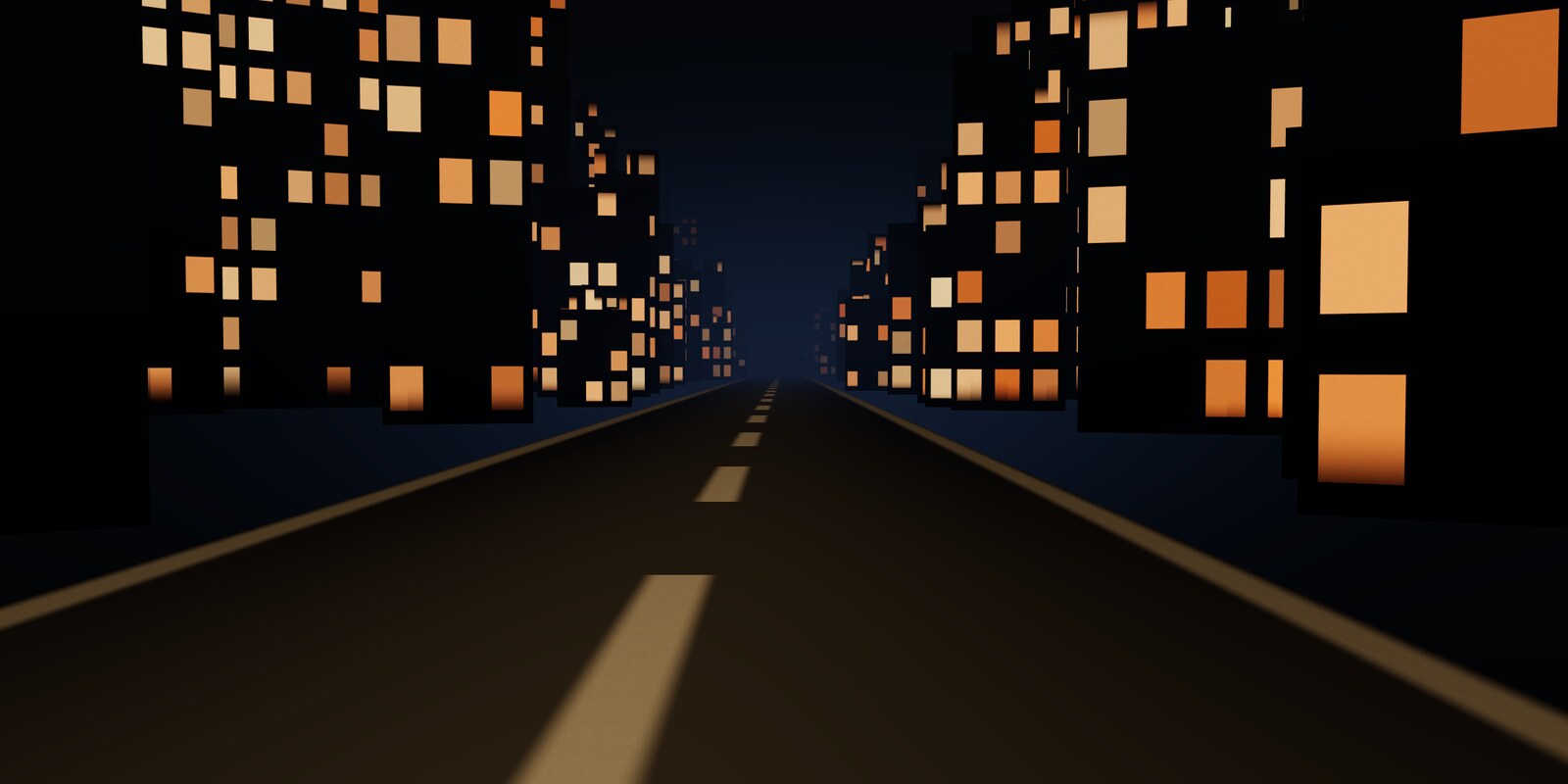
A client site for a wellness education and coaching practice needed an opening that did more than decorate. What shipped on 2026-08-20 is a four act film you scroll: the camera falls out of the night sky toward a city, stands up out of that fall to look along a street, travels the street at eye height, and arrives at a horizon the page then rises out of.
The film is the argument rather than the wrapping. A fall is something that happens to you. A road is something you travel. That distinction is the whole reason the camera had to learn a new move.
One number owns everything
There is exactly one scroll scalar. A single ScrollTrigger writes it, and every other part of the film reads it: which plate is on the canvas, which sequence owns the frame, where the corridor camera is, how thick the fog is, which station is lit. Nothing is React state, because all of it is read inside a render loop and state that re-renders a tree 60 times a second is not state, it is a stutter.
The four acts tile that scalar end to end with no gaps between them. The project's own law says nothing should be legible during a camera move, and the first draft honored it by putting empty scroll between the acts. That was wrong, and the reason is worth keeping: an act boundary is not a pause, it is a handover. A gap between two acts is a stretch of scroll where no sequence owns the frame, which is a held picture with nothing driving it. The silence belongs in the copy windows, where the argument for silence actually applies, and those windows still have it.
Two sequences, one canvas, and a cut that had to be earned
Act 1 is 133 pre-rendered plates, taken from a 160 frame descent. The 27 that were dropped are not damaged frames. They are the last of the pure straight down approach, engineered for a rooftop landing this film no longer performs. The pitch point was ruled at frame 132, at an altitude of 925 m, because the street grid is already readable from there. Pitching over any later would have spent the film's signature move on a dark rectangle.
Act 2 is 41 new frames at 1440x1080, and they were rendered twice. The first pass solved the street channel out of the city massing so the camera would stand up along a real street rather than a chosen one. The second pass added the bank, on a ruled tilt curve, so the horizon rolls as the camera comes level instead of snapping flat.
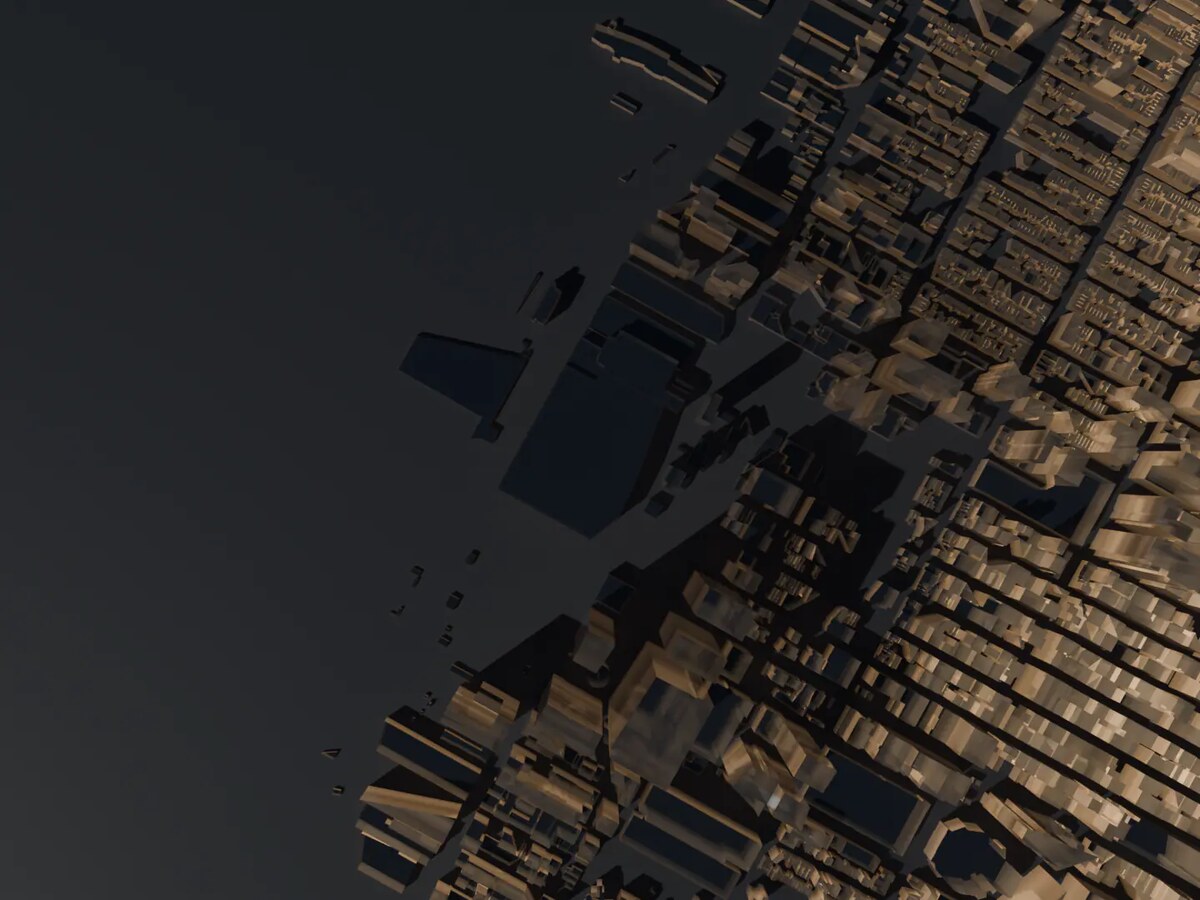
The join between the two sequences is a hard cut, and it is allowed to be a hard cut because it was measured rather than assumed. The last plate of act 1 and the first plate of act 2 sit 1.72 of 255 apart in the mean, with 0.12% of the frame more than 12 of 255 apart. The ordinary steps on either side of that join are 11.12 and 22.07. The cut is a smaller change than a normal frame advance, so a cross fade would have been a dissolve added to hide nothing. Both sequences share one canvas and one scrub, which makes the swap a frame change and nothing else: no fade, no second layer, no compositing.
The jank was pacing, and only an instrument could tell
The client's note after the first smoothness pass was that the transition into the horizontal shot felt like it was bottlenecking or just being weird. Three suspects were obvious. Two were innocent, and the measurement is what cleared them: the cut was innocent, as above, and decoding was innocent too.
The guilty party was that the plates were being played at wildly uneven speed. Inside act 2 alone, peak to trough in how much the picture changed per unit of scroll ran 149 to 1. The reader was crossing some of the rotation in a blink and grinding through the rest.
The fix was scroll rather than pixels, and it is the measurement inverted. The act's local progress is remapped by taking the measured flow profile, raising it to a power, and integrating it, which is the same partial arc length reparameterisation used to space points evenly along a curve. Two conditions were solved on it rather than tuned by feel. The join is rate continuous, so act 2's first step runs at act 1's exit rate exactly, which took a 17% surge down to 1.5%. And a floor under the profile stops the 25 near identical plates at the end of the act from claiming the entire scroll budget.
The exponent was ruled, not picked. Scored across the whole act the number is meaningless, because act 2 eases to a standstill and a log slope goes to infinity there. Scored across the window the client actually named it falls from 148 to 62, and it is flat between exponents 0.4 and 0.7. That flatness is the useful finding: half measures do not move this. Either the profile is flattened properly or it is not worth touching at all.
The curve is carried as nine velocities rather than nine positions, and that was also measured. Nine positions reproduce the same remap to within a quarter of a plate, but they put a 37% velocity step at each of eight interior knots, which is twice the size of the join step this entire exercise existed to remove. Nine velocities cost the same nine numbers, integrate in closed form to a piecewise quadratic, and cannot lurch by construction.
The seam had to be photographed layer by layer
Act 3 leaves the plates behind and runs live. The handoff is a fade across a window of scroll, under three rules the project already held: land on a low motion stretch, match the colour underneath by measurement, and drop the dead layer out of compositing entirely once it is invisible.
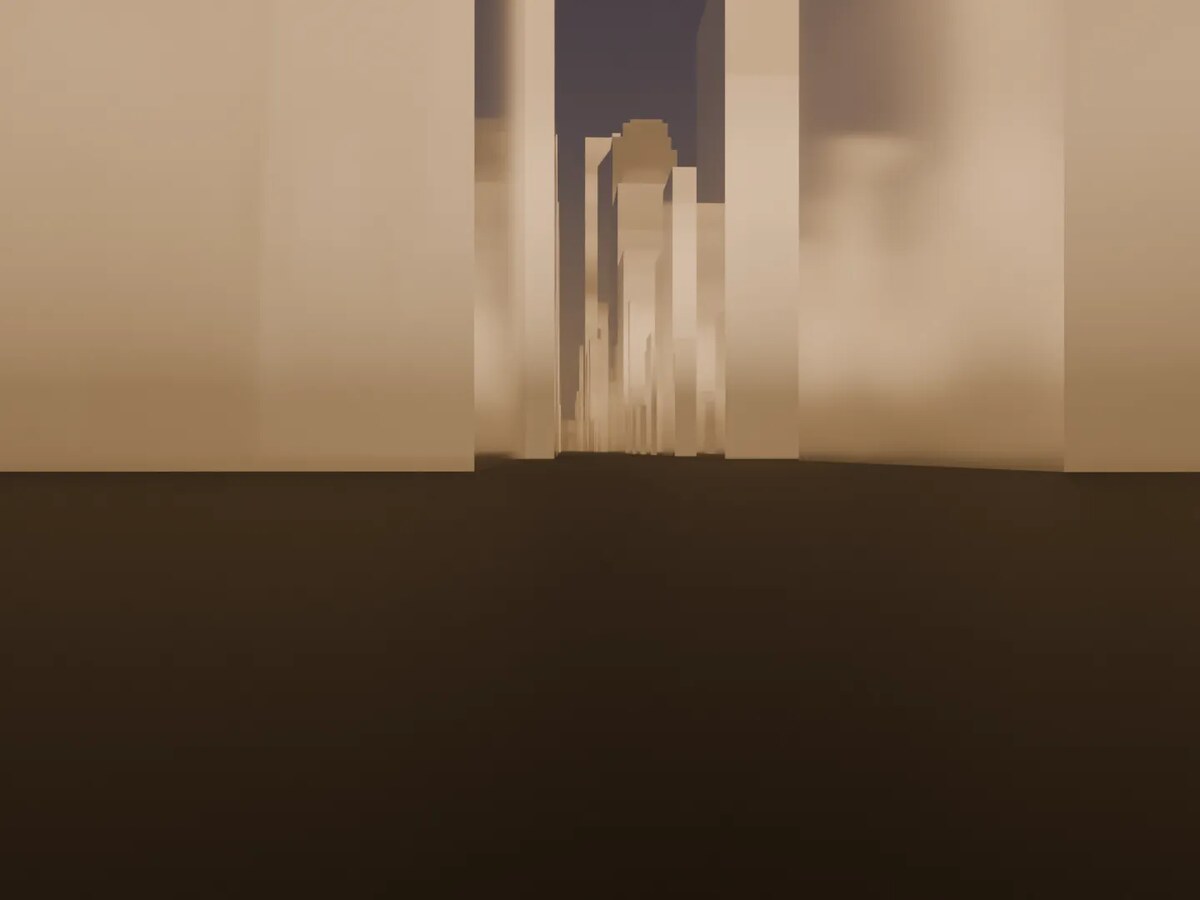
The window was ending at the wrong place, and it was wrong twice. Finding both took photographing the seam in three layers at every step of the window: the shipped composite, the plate alone, and the live scene alone.
The first fault was that the plate freezes before the window closes, so two fifths of the fade was a cross fade between two still pictures. A cross fade under motion is invisible. A cross fade between two stills is a visible dissolve, and the film's own seam law says so, and it was happening at the bottom of the very window that law governs.
The second fault was arithmetic on the wrong denominator. The live scene runs its own dawn settle against the remainder of the film, not against act 3, so by the old end point the corridor was already a third of the way through that settle. The plate was being colour matched against a colour that had left. Ending the fade where the plates end puts the last frame of it at exactly zero on the corridor's clock, where the live scene is still sitting on the plate's measured exit value.
What the window cannot do is make the two pictures match. The plate's last frames wash to a bright haze while the live corridor is a dark street with lit windows, and they are 47 of 255 apart. No timing fixes that. What good timing buys is spending half as much scroll on the disagreement and spending all of it under motion, which is the most a seam is allowed to do. The rest is a re render, and it is written down as such.
The parts that are allowed to be boring
The corridor is billboarded cards staggered in depth, which means its length is free. When the total runway came down from 1200 viewport heights to 950, no act had to be re-timed and no frame had to be re-rendered, because the acts are fractions of the scalar and the corridor's filler absorbs the difference. That was the elasticity claim being spent rather than described.
The runway came down because scrolling it was a chore, and the real cause was gain rather than length: at the old settings one mouse notch travelled 0.44% of the film, so crossing it took 227 of them. Mediating the scroll took one notch to 5.00%. The trim removed the slack that was left over.
Three more things exist because a demo can fail in a room. There is a complete second version of the site with the film removed: same copy, one still picture, no canvas, no scroll scalar, no dynamic import, and it is identical with scripting turned off. The plate player degrades a missing sequence to the held last frame of act 1 rather than to a blank, because a held frame reads as a slow connection and a blank reads as a broken site, and a stale CDN or a partial upload puts a real reader on that path. And the email capture on every ending is visibly present and provably inert, which is the honest state of it until there is something to sign up for.
The film's spine is deliberately a second spine rather than an extension of the homepage's. The homepage is the guaranteed fallback, and a route being assembled the afternoon before it is shown must not be able to break the thing it is the fallback for.
What it runs on
Next.js 15.5 on the App Router, React 19.2, TypeScript 5.9, three.js 0.185 through React Three Fiber, and no CSS framework at all: the design system is hand written custom properties. The frames come out of Blender scripts that live in the repo, and the frames themselves are build artefacts rather than source.
Every line of copy is typed data in one directory, and no component holds any of it. That is not tidiness. It means a rewrite is a data change that a non developer can read in a diff, which is the difference between a client being shown their words and a client being able to check them.
The engineering debt is written down in the same repo as a numbered register, currently 40 entries deep, including the ones found the day of the handover. One of those is a build that was run against a live server and served a site with dead JavaScript, caught by a QA pass before the demo rather than during it. The register exists so that the next person to touch this, including me in six months, inherits the list rather than rediscovering it.
This entry covers client work. The technique is the subject; the client's business is theirs.