From PS2 to Photoreal in One Day
Our digital twin of Montauk Point looked like an early PS2 game. One day later it did not. The ladder: path tracing, a physical sky, procedural trees, and a living ocean.
We are building a survey-accurate digital twin of Montauk Point — the lighthouse, the bluffs, the decommissioned Cold War radar at Camp Hero, the ocean that hits all of it. Every dimension is traceable to a source: 1860 survey drawings, USACE engineering sheets, USGS lidar. The geometry was true. It also looked like an early PS2 game.
That is not an insult. Getting to "competent PS2 game" from nothing taught us the entire pipeline. But truth deserves better light, so we spent one day climbing what we now call the hero ladder — same shot, four rungs.
Rung 1: real light
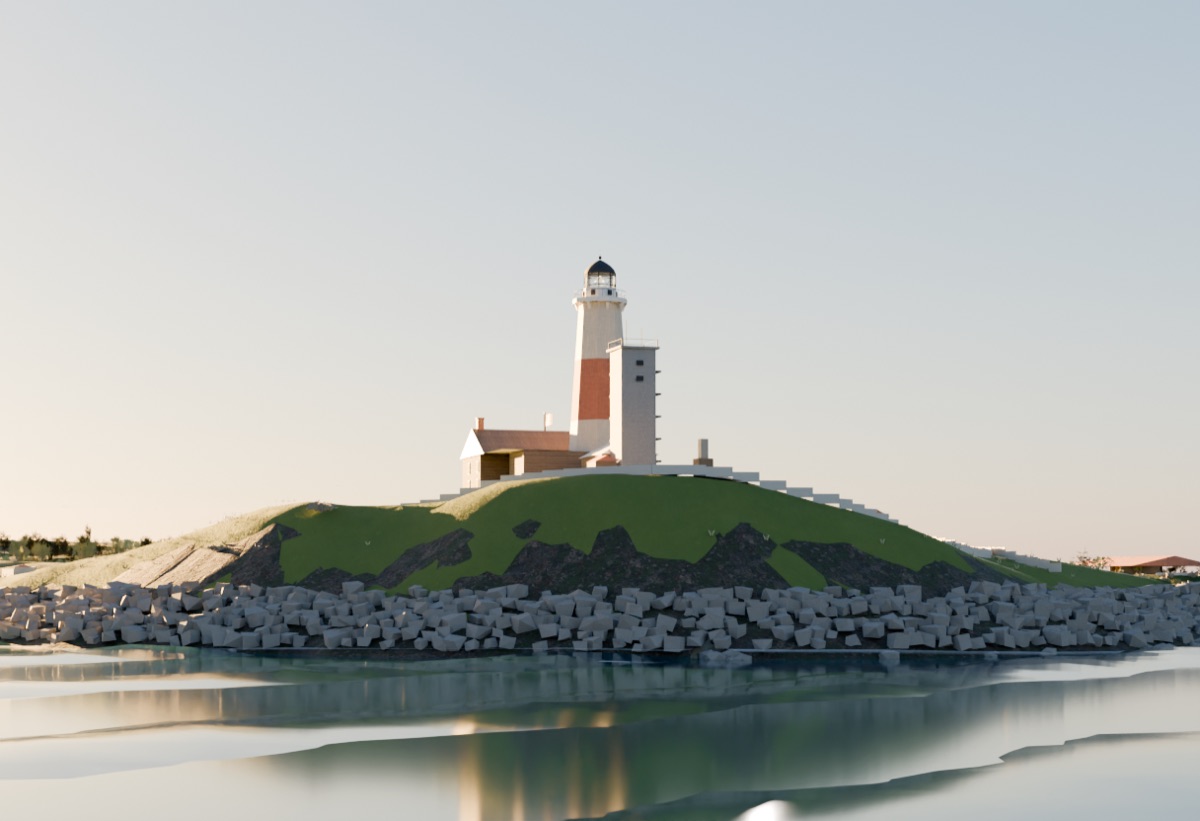
The single biggest source of the PS2 feel was the renderer. Real-time engines approximate light; a path tracer simulates it — every bounce, every soft shadow, every reflection earned. Switching the finals pipeline to Cycles (GPU, denoised) killed most of the toy look in one move, before we changed a single asset.
The doctrine that made this cheap: the fast engine iterates, the slow engine ships. Prints are stills. Render minutes are free at 3 a.m.
Rung 2: a sky that exists
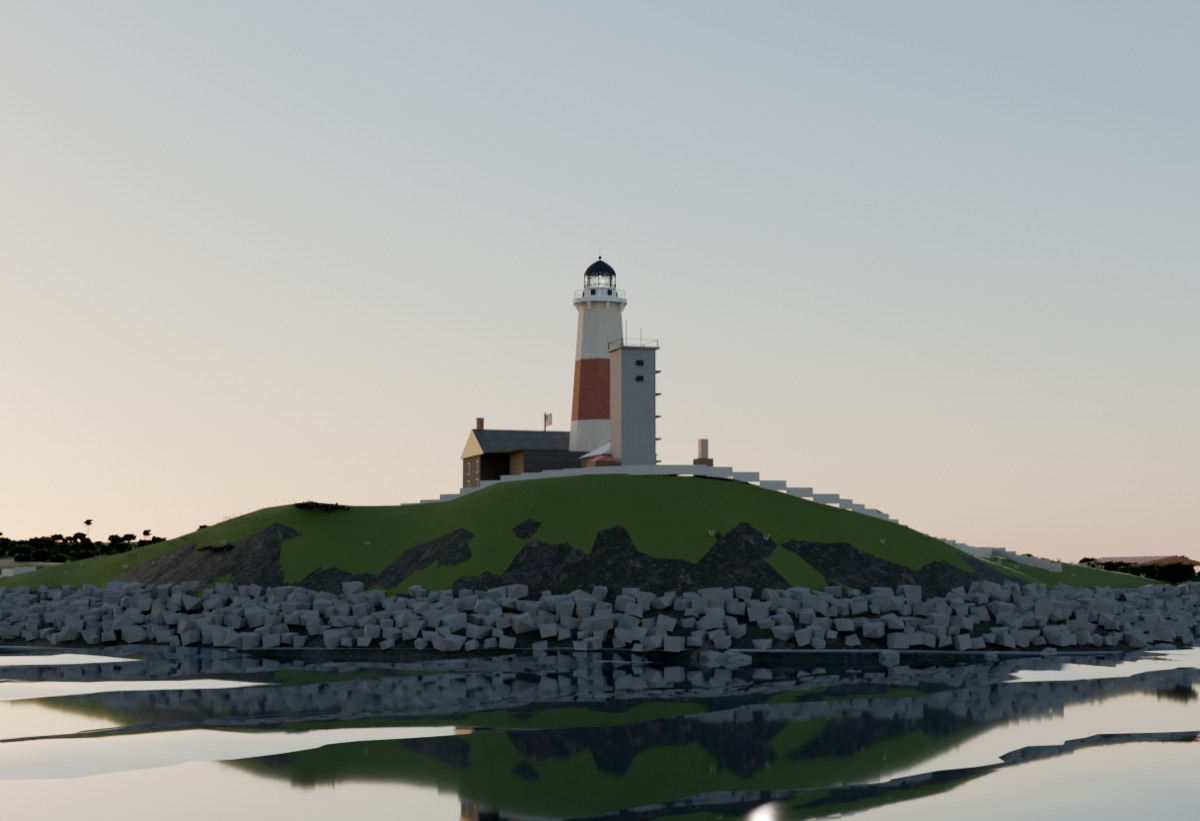
Our world had no atmosphere — a flat gradient pretending to be sky. Blender's spectral sky model computes actual atmospheric scattering: the peach horizon at dusk is physics, not a color pick.
Same rung, second move: the trees. Photoscanned tree assets were 17 million triangles each and decimated to skeletons. We wrote our own generator instead — about 100 lines of recursive growth — and grew eight variants tuned to Montauk's salt-stunted ecology: pitch pine, scrub oak, red cedar. A thousand instances share those eight meshes. The entire forest costs about one megatriangle.
Rung 3: kill the mirror
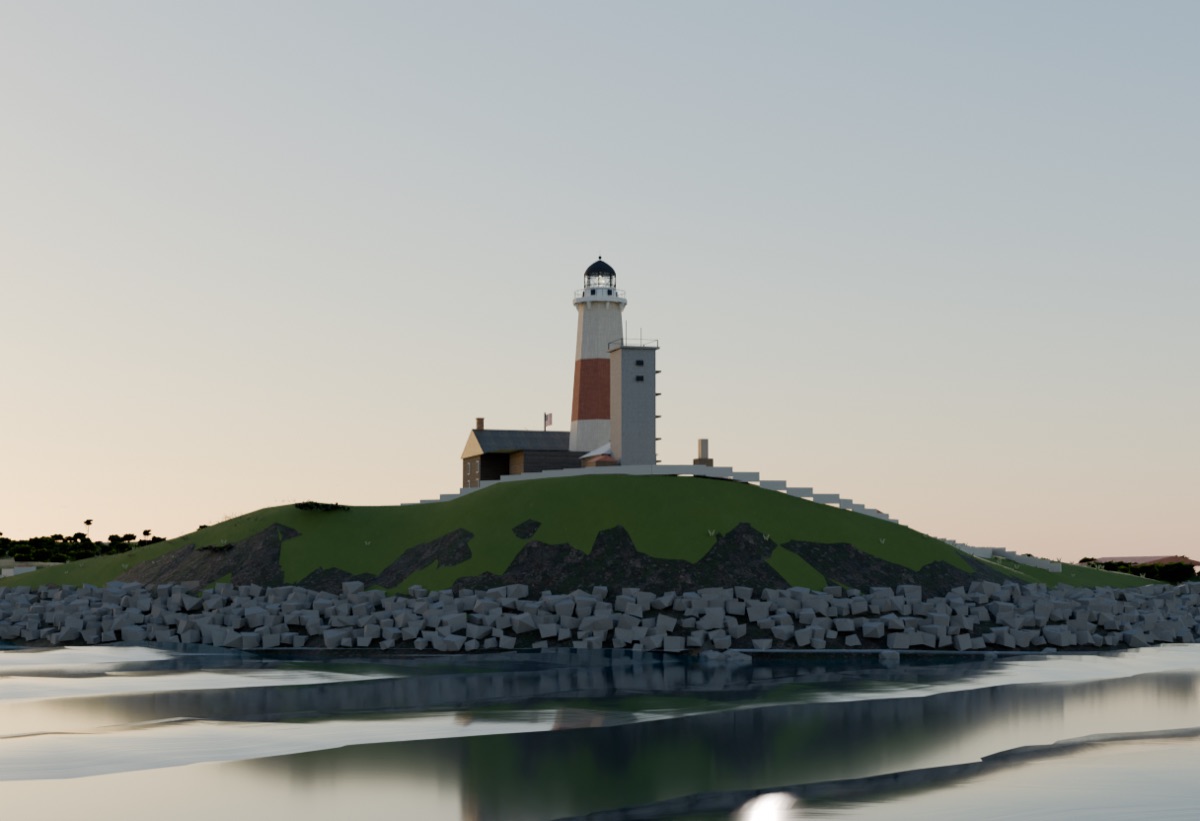
Water is the biggest tell in any landscape render, and ours was a dead mirror. The fix was not more geometry — it was microstructure: surface roughness tuned to open-Atlantic conditions plus two octaves of wavelet bump. The reflections shattered into textured evening water, and the frame stopped being a diorama.
What the ladder taught us
- Diagnose before decorating. Naming the specific causes of the toy look (flat light, no air, mirror water, sprite trees) turned "make it better" into four solvable problems.
- Own your generators. The tree code is ours; wind-shear is now a growth parameter, not a post-effect.
- Author for the color pipeline. Filmic tone mapping crushes saturated greens at midday — palettes must be authored darker than the target. We learned this the expensive way.
The twin now takes real data as input — NOAA tides, wave climatology, 180 years of storm tracks — and the ladder keeps going. Next rungs: cloud systems, surf at the revetment toe, film grade.
Built by SeaRaven Studios. The methodology series covers each rung in depth.